The guilty man set free
Bar-Abba
In Scripture · Backstory original
Witness III of VI · Dark bronze
02 In one line
The guilty man who stood on the pavement and watched his own cross given away to somebody else.
03 In the books
The elder son of a proud landholding family whose olive terraces — and whose old name — were taken not by a sword but by a ledger. A soft-handed man with a wax tablet came, and proved in figures that the land was already gone, and had been for some time. The boy watched his father stand in the dust of his own terraces in the posture of a beggar, and something happened in his chest that did not unhappen for forty years.
Shame curdled into rage; rage found the short daggers of the sicarii. The boy with a hopeful name buried it so deep under Bar-Abba — son of the father — that he half forgot it was ever his. He became a name Rome was nervous about. And then a rising failed, and a brother was lost on a road, and the rage finally ran out, and what was left underneath was not peace but the hollow the rage had filled.
He was in a cell waiting for a cross that had been built for him, doing the arithmetic of his own life and getting the same answer as the man with the tablet — already gone — when a crowd outside chose a name. His. He walked out through the light past the innocent man taking his place, and spent a year unable to stop staring at the substitution, until the asking led him at last to a widow’s open door in the lower city, with a lopsided pomegranate carved into the lintel.
04 In Scripture
Matthew 27:16–26; Mark 15:7–15; Luke 23:18–25; John 18:40. The prisoner released by Pilate in Jesus’s place, at the crowd’s demand. Mark calls him a rebel who had committed murder in an insurrection.
His name means son of the father in Aramaic. Some early manuscripts of Matthew even call him Jesus Barabbas — so that Pilate’s question becomes a choice between two men named Jesus, one of them literally son of the father.
The Bible tells us nothing of his family, his past, or his end. The terraces, the ledger, the sister and the homecoming are the story’s own.
Matthew 27:16–26
16They had then a notable prisoner, called Barabbas. 17When therefore they were gathered together, Pilate said to them, “Whom do you want me to release to you? Barabbas, or Jesus, who is called Christ?” 18For he knew that because of envy they had delivered him up. 19While he was sitting on the judgment seat, his wife sent to him, saying, “Have nothing to do with that righteous man, for I have suffered many things today in a dream because of him.” 20Now the chief priests and the elders persuaded the multitudes to ask for Barabbas, and destroy Jesus. 21But the governor answered them, “Which of the two do you want me to release to you?” They said, “Barabbas!” 22Pilate said to them, “What then shall I do to Jesus, who is called Christ?” They all said to him, “Let him be crucified!” 23But the governor said, “Why? What evil has he done?” But they cried out exceedingly, saying, “Let him be crucified!” 24So when Pilate saw that nothing was being gained, but rather that a disturbance was starting, he took water, and washed his hands before the multitude, saying, “I am innocent of the blood of this righteous person. You see to it.” 25All the people answered, “May his blood be on us, and on our children!” 26Then he released to them Barabbas, but Jesus he flogged and delivered to be crucified.
Mark 15:7–15
7There was one called Barabbas, bound with his fellow insurgents, men who in the insurrection had committed murder. 8The multitude, crying aloud, began to ask him to do as he always did for them. 9Pilate answered them, saying, “Do you want me to release to you the King of the Jews?” 10For he perceived that for envy the chief priests had delivered him up. 11But the chief priests stirred up the multitude, that he should release Barabbas to them instead. 12Pilate again asked them, “What then should I do to him whom you call the King of the Jews?” 13They cried out again, “Crucify him!” 14Pilate said to them, “Why, what evil has he done?” But they cried out exceedingly, “Crucify him!” 15Pilate, wishing to please the multitude, released Barabbas to them, and handed over Jesus, when he had flogged him, to be crucified.
Luke 23:18–25
18But they all cried out together, saying, “Away with this man! Release to us Barabbas!”— 19one who was thrown into prison for a certain revolt in the city, and for murder. 20Then Pilate spoke to them again, wanting to release Jesus, 21but they shouted, saying, “Crucify! Crucify him!” 22He said to them the third time, “Why? What evil has this man done? I have found no capital crime in him. I will therefore chastise him and release him.” 23But they were urgent with loud voices, asking that he might be crucified. Their voices and the voices of the chief priests prevailed. 24Pilate decreed that what they asked for should be done. 25He released him who had been thrown into prison for insurrection and murder, for whom they asked, but he delivered Jesus up to their will.
John 18:40
40Then they all shouted again, saying, “Not this man, but Barabbas!” Now Barabbas was a robber.
05 His world
The violent underside of the occupation: the Zealots and sicarii who answered Rome’s lawful theft with unlawful blades — and the tax-farming system that could ruin a family completely without anyone ever breaking a law.
06 What he carries
The last loophole closed. The thief was small. The soldier was following orders. But Bar-Abba gave the orders to himself — the one man in the city for whom a cross was literally, particularly built, who watched another man carry it up the hill in his place. If grace reaches him, there is nobody left outside.
And his true name is not traded for another but redeemed: he really is a son of the Father. The name had only ever been pointing at the wrong one.
07 A lesson
The thing you built to protect yourself — the knife, the grievance, the hardness — is the very thing you have to set down to be carried home. And no name is too far gone to be redeemed rather than replaced.
08 Threads
He prays in the cell beside Demas and sets himself against the thing the boy receives. Aziz strikes off his irons on the Pavement, and thirty years later the two of them sit at the same table and find they are brothers. He is carried at last to Miriam’s house — the mother of the man who died on the middle cross’s right hand — and she steps back, opens the door wider, and says: you’ll be hungry. Come in. And to his sister Adina, whose lamp had stayed lit for him for forty years.
- Demas — Prays beside himThe cell · Barabbas · Remember Me
- Longinus — His irons struck offThe Pavement · Barabbas · The Centurion
- Miriam — “You’ll be hungry. Come in.”The lower city · The Gathering
09 Where they stood
10 Hear the opening
11 His book
Barabbas (Book III)
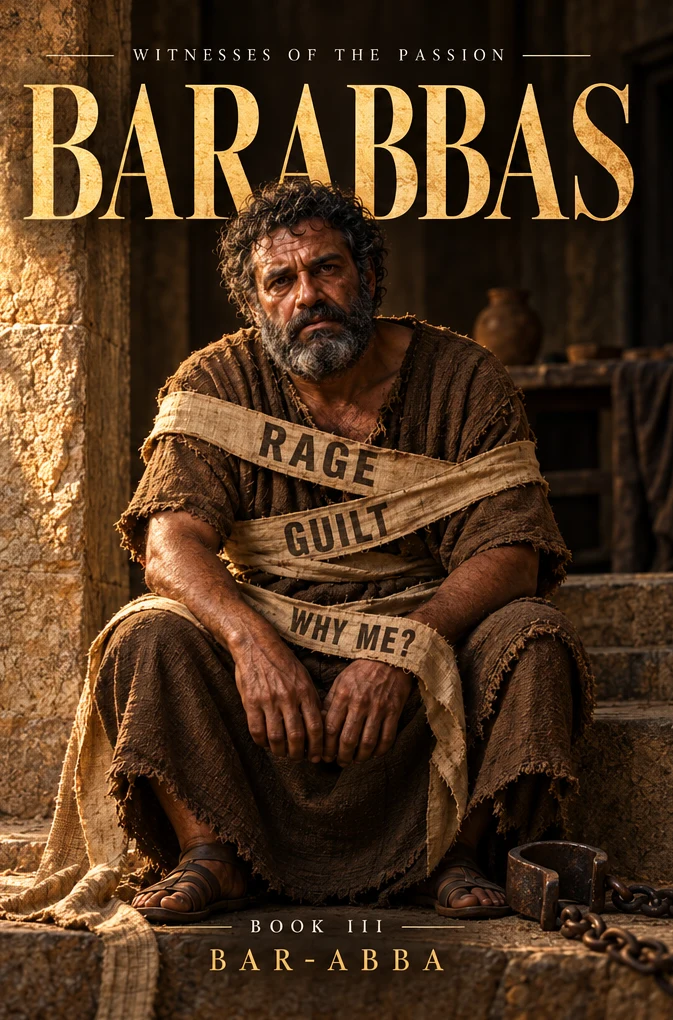
Book Three
Barabbas
The guilty man who watched his own cross given away.
Ebook · Paperback · Hardcover — From £4.99 (sample)
Which is harder to believe — that grace would reach the worst person you can think of, or that it would then seat you at the same table as them?